Showing posts with label मेडिटेशन. Show all posts

Thursday, September 20, 2012

संतुलन ध्यान

ध्यान

लाओत्से के साधना-सूत्रों में एक सूत्र है लाओत्से की ध्यान की पद्धति का। वह सूत्र यह है।
लाओत्से कहता है कि पालथी मार कर बैठ जाएं और भीतर ऐसा अनुभव करें कि एक तराजू है, बैलेंस, एक तराजू। उसके दोनों पलड़े आपकी दोनों छातियों के पास लटके हुए हैं और उसका कांटा ठीक आपकी दोनों आंखों के बीच, तीसरी आंख जहां समझी जाती है, वहां उसका कांटा है। तराजू की डंडी आपके मस्तिष्क में है। दोनों उसके पलड़े आपकी दोनों छातियों के पास लटके हुए हैं। और लाओत्से कहता है, चौबीस घंटे ध्यान रखें कि वे दोनों पलड़े बराबर रहें और कांटा सीधा रहे।

लाओत्से कहता है कि अगर भीतर उस तराजू को साध लिया, तो सब सध जाएगा। लेकिन आप बड़ी मुश्किल में पड़ेंगे! जरा इसका प्रयोग करेंगे, तब आपको पता चलेगा। जरा सी श्वास भी ली नहीं कि एक पलड़ा नीचा हो जाएगा, एक पलड़ा ऊपर हो जाएगा। अकेले बैठे हैं, और एक आदमी बाहर से निकल गया दरवाजे से। उसको देख कर ही, अभी उसने कुछ किया भी नहीं, एक पलड़ा नीचा, एक ऊपर हो जाएगा।
लाओत्से ने कहा है कि भीतर चेतना को एक संतुलन! दोनों विपरीत द्वंद्व एक से हो जाएं और कांटा बीच में बना रहे।
जीवन में सुख हो या दुख, सम्मान या अपमान, अंधेरा या उजाला, भीतर के तराजू को साधते चला जाए कोई, तो एक दिन उस परम संतुलन पर आ जाता है, जहां जीवन तो नहीं होता, अस्तित्व होता है; जहां लहर नहीं होती, सागर होता है; जहां मैं नहीं होता, सब होता है।

साभार : ओशो हिंदी

Friday, July 13, 2012

ध्यानपूर्ण मन….

meditation2

ध्यानपूर्ण मन शांत होता है। यह मौन विचार की कल्पना और समझ से परे है। यह मौन किसी निस्तब्ध संध्या की नीरवता भी नहीं है। विचार जब अपने सारे अनुभवों, शब्दों और प्रतिमाओं सहित पूर्णत: विदा हो जाता है, तभी इस मौन का जन्म होता है। यह ध्यानपूर्ण मन ही धार्मिक मन है-धर्म, जिसे कोई मंदिर, गिरजाघर या भजन-कीर्तन छू भी नहीं पाता।
धार्मिक मन प्रेम का विस्फोटक है। यह प्रेम किसी भी अलगाव को नहीं जानता। इसके लिए दूर निकट है। यह न एक है न अनेक, अपितु यह प्रेम की अवस्था है जिसमें सारा विभाजन समाप्त हो चुका होता है। सौंदर्य की तरह उसे भी शब्दों के द्वारा नहीं मापा जा सकता। इस मौन से ही एक ध्यानपूर्ण मन का सारा क्रियाकलाप जन्म लेता है।
ध्यान जीवन की महानतम कलाओं में से एक है- बल्कि शायद यही महानतम् कला है। यह कला संभवत: दूसरे से नहीं सीखी जा सकती-और यही इसका सौन्दर्य है। ध्यान की कोई तकनीक और तरकीब नहीं होती, इसलिए इसका कोई अधिकारी और दावेदार भी नहीं होता। जब आप स्वयं का निरीक्षण करते हुए अपने बारे में सीखते हैं, अर्थात् किस तरह आप खाते-पीते हैं, किस ढंग से आप चलते-फिरते हैं, क्या बातचीत और गपशप करते हैं, आपका ईर्ष्या करना, नफरत करना-जब आप अपने भीतर और बाहर इन सारी चीज़ों के प्रति सचेत होते हैं, बिना किसी कांट-छांट के, तो यह ध्यान का ही अंग है।
और यह ध्यान हर जगह हर समय हो सकता है: जब आप किसी बस में बैठे हों या जब आप धूप और छाया से परिपूर्ण किसी वनस्थली में टहल रहे हों या जब आप पक्षियों के कलरव-गान को सुन रहे हों या जब आप अपनी पत्नी या अपने बच्चे के चेहरे को देख रहे हों।
ध्यान का सहसा सर्वाधिक महत्त्वपूर्ण हो जाना कितना अद्भुत और विचित्र है ! ध्यान-जिसका न आदि है न अन्त। यह वर्षा की एक बूँद के समान है। इसी बूंद में छिपी हैं सारी की सारी नदियां और जलधाराएं, इसी में समाये हैं बड़े से बड़े समुद्र और जल-प्रपात। जल की यह बूँद पृथ्वी को भी पोषण देती है और मानव को भी। इसके बिना तो यह धरती रेगिस्तान बन जाती ! ध्यान के बिना हमारा हृदय भी ऊसर-बंजर मरुस्थल हो जाता है।
ध्यान का अर्थ यह पता लगाना है कि अपनी सारी गतिविधियों और अपने सारे अनुभवों समेत मस्तिष्क क्या पूर्णत: शान्त हो सकता है। बाध्य होकर नहीं, क्योंकि जिस क्षण आप इसे बाध्य करते हैं, फिर से द्वैत आ खड़ा होता है, और वह सत्ता भी, जो कहती है, ‘‘अद्भुत अनुभूतियों के जगत में प्रवेश के लिए मुझे अपने मस्तिष्क को नियंत्रित कर शान्त कर लेना चाहिए’’-ऐसा कभी संभव नहीं होगा।
लेकिन अगर आप विचार की सारी खोजों और गतिविधियों को, इसके भय, सुखों और संस्कारों को देखने, सुनने और समझने लग जायें, अगर आप अपने मस्तिष्क का निरीक्षण करने लग जायें कि यह किस तरह कार्य करता है, तो आप देखेंगे कि मस्तिष्क असाधारण रूप से शान्त, मौन हो जाता है। यह शांति निद्रा नहीं है बल्कि यह प्रचंड रूप से सक्रिय है और इसलिए शांत है। विद्युत उत्पन्न करने वाला एक बड़ा यंत्र जब अच्छी तरह कार्य करता है तो इससे शायद ही कोई ध्वनि निकलती हो। ध्वनि और शोर-गुल तभी पैदा होता है जब कहीं घर्षण होता है।
मौन और विस्तार का आपसी मेल है। मौन की अनंतता वह अनंतता है जिसके भीतर का केन्द्र मिट चुका है।
जे. कृष्णमूर्ति

Wednesday, May 23, 2012

वर्तामान और सचेतावस्था मे जीना

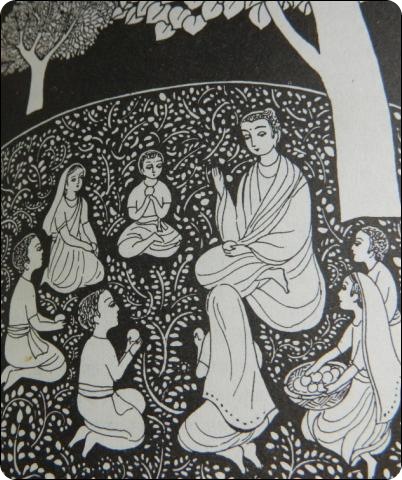
बच्चे सचेतावस्था मे भगवान बुद्ध के साथ

संबोधि प्राप्ति के पशचात गौतम बुद्ध ने उरुबेला गांव  के बच्चों से वन से जाने की आज्ञा माँगी । सुजाता, नंद बाला , सुभाष , स्वास्ति और रुपक उनके इस कथन से विस्मित से रह गये । सिदार्थ ने सुजाता और अन्य बच्चों से कहा कि आज वह तीसरे पहर बच्चों से वन मे मिलना चाहते हैं ताकि जो संबोधि का मार्ग उन्होने चुना है उसको वह उन्हें बाँट सकें ।

उनके बताये समय के अनुसार बहुत से बच्चे आये और सब पीपल के वृक्ष के पास घेरा बना के बैठ गये । सुजाता अपने साथ नारियल और ताडगुड की बट्टियाँ  उपहार स्वरुप लायी थी और वहीं नंद बाला और सुभाष अपने साथ टॊकरी में मिठ्ठे ( संतरे जैसा फ़ल ) लाया था । सब बच्चॊ ने आदर भाव से सिद्धार्थ को नमन किया और फ़लस्वरुप सिद्धार्थ ने उनको बैठ जाने को कहा । सिद्धार्थ ने बच्चों से कहा , “ तुम सब बच्चे समझदार हो और मुझे विशवास है कि जो मै तुम्हें बताउगाँ उन पर तुम अमल करोगे । जो मार्ग मैने सदधर्म का चुना है वह बहुत गूढ और सूक्ष्म है लेकिन जो भी उस पर अपना ह्रदय और चित्त लगायेगा वह उसे समझ सकता है और उस पर चल सकता है । ”

बच्चों जब तुम संतरे को छीलकर खाते हो तो उसे सचेतावस्था के साथ भी खा सकते हो और बगौर जागरुक रह कर भी । जब तुम मिट्ठा खाओ तो तुम को भली भाँति ज्ञान हो कि तुम मिट्ठा खा रहे हो । तुम उसकी गंध और स्वाद को आत्मसात करो । जब तुम उसका छिल्का उतारो तब भी सजग रहो और जब उसकी फ़ाँक मुँह में रखो तब भी । जब तुम इस फ़ल की गंध और मिठास को अनुभव करो तो उस अनुभूति के प्रति भी सजग रहो ।  इस मिठ्ठे को देखकर चेतनावस्था का अभ्यास करने वाला सृष्टि की अदभुतताओं को समझ सकता है कि किस प्रकार समस्त वस्तुयें  एक दूसरे  के प्रति क्या क्रिया प्रतिक्रिया करती हैं । सचेतावस्था का अभ्यास करने वाला व्यक्ति इस मिठ्ठे में वे चीजें देख सकता है जिसे अन्य लोग देखने मे असमर्थ रहते हैं । सचेत व्यक्ति  मिठ्ठे का पेड देख सकता है , वसन्त ऋतु  मे मिठ्ठे को फ़लता देख सकता है , उस धूप और वर्षा को देख सकता है जिससे मिठ्ठे के पॆड का पोषण होता है और गहराई से देखने पर वह उन बातों को जान लेता है जिनके स्व्बरुप मिठ्ठा पककर तौयार होता है ।

नंद ने जो मुझे मिठ्ठा दिया है उसमें नौ फ़ाँके हैं । जिस प्रकार मिठ्ठे की नौ फ़ांके हैं उसी प्रतिदिन के चौबीस घंटॆ होते हैं । एक घंटा  मिठ्ठे की एक फ़ांक के समान  है । दिन के चौबीस घंटॊं को जीना इस मिठ्ठे की सभी फ़ांको को खा लेने के समान है । मेरा मार्ग दिन के प्रत्येक घंटे को  सचेतावस्था के साथ जीना है जिसमे चित्त और शरीर हमेशा वर्तमान पर केन्द्रित हो । यदि हम अचेतावस्था में जी रह होते हैं तो हम जानते नही कि हम जी रह रहे हैं । हम जीवन का पूर्ण अनुभव इसी कारण नही कर पाते क्योंकि हमारा चित्त और शरीर वर्तमान को पूर्णता के साथ जीता ही नही है । “ बच्चों , सचेत होकर मिट्ठा खाने का अर्थ है कि तुम वास्तव में उसके संपर्क में हो । उस समय बीते हुये कल या आगामी कल के विचारों मे खोये हुये नही बल्कि पूरी तरह से इस क्षण को जी रहे हो । चेतन  जागरुकता का अर्थ है वर्तमान के इस क्षण को पूर्णता के साथ जीना जिसमें तुम्हारा चित्त्त और शरीर इस समय यहाँ हों ।”

इसी तरह  बच्चों सचेतावस्था में जीने वाला व्यक्ति जानता है कि वह क्या सोच रहा है , क्या कह रहा है और क्या कर रहा है । ऐसा व्यक्ति उन विचारों , शब्दों या कार्यों से बच सकता है  जिनसे उसे स्वयं  तथा दूसरे को कष्ट हो और इसी समझ और  ज्ञान से सहनशीलता और प्रेम का उदय होता है । फ़लस्वरुप संसार में अधिक कष्ट नही रह जाते ।

स्त्रोत : सतिपत्थन सुत्त्त , सचेतावस्था से जुडा विचार से लिया गया है ।  तिक न्यात हन्ह ( Thich Nhat Hanh ) की पुस्तक जहं जहं चरन पडे गौतम के ( Old paths white clouds )- प्रकाशक ‘हिन्द पाकेट बुक ’

Friday, August 27, 2010

Buddhism vs. Bhagavad-Gita

BUDDHA-Buddhism-Light    

bhaga

In this paper I will attempt to compare and contrast the two works, “What the Buddha Taught”, which is based on the Pali texts of Tipitaka, and the “Bhagavad-Gita-The Song of God” by beginning with Buddhism for the first and every other paragraph thereafter, then continuing with Bhagavad-Gita for the second and every other paragraph thereafter. I am hoping this will help maintain a clear understanding of the comparisons I am making to each work throughout the paper.


There are still many similarities between the two works. They both try to teach us not to become so attached to the material world around us. They say the more you let go of the material world around you, the happier you will live your life on earth. If we give in to our desires, whether that be sex or greed, we only allow ourselves to suffer more and will never truly know completehappiness.

Buddhism is unique to every other religious belief because Buddha was a man who did not claim to be a God, nor a son of God. His teachings only claim is that man and only man can liberate himself through the impermanence of Dukkha and find ultimate happiness in his life. His own life on earth was said to be as a Buddha living a life of “par excellence.” He was referred to as a Supreme Being. It is through his life experience and wisdom that he promises to show us the path to Nirvana. The writings were originally done in Sanskrit, but they are what the Buddha taught and how the Buddha lived and why millions of people practice Buddhism today and millions more will tomorrow.

Bhagavad-Gita is also translated from Sanskrit, but is a religious doctrine of prose and song. It speaks of God being in all things as Brahman and inside each of us as Atman. Arjuna is the student and Krishna is God in a form Arjuna can see and hear. Bhagavad-Gita is a spiritual guide that is meant to show the impossibilities of judging thy neighbor because each of us can be faced with choices that are very hard to make and would not be able to explain to someone else. Still, it tries to show that as long as the choices you make are not based on greed, or evil and is a battle meant to be won for the good of mankind, then in the eyes of God, it is a battle worth fighting for. The Gita is an astonishing work that appeals to all religions and all cultures which is something that no other book can claim to be able to do. Many great men have used it as their spiritual guide, like Gandhi, and say that the there are passages within it to help man when he is struggling with difficulties in his life. The Gita teaches us about the Supreme Reality and tries to teach us how to break the chains of desire which bind us to our actions.

Buddhism teaches us about the five aggregates, the first aggregate of matter, the second of sensations, the third of perceptions, the fourth of mental formations and the fifth of consciousness. The first aggregate is the most important because it also contains the four great elements which are solidity, fluidity, heat and motion. It also contains the derivatives of the four great elements which are the five material sense organs which are the eye, ear, nose, tongue and body and their corresponding opposites in the external world which are visible formations, sounds, odors, tastes and tangible things. Thoughts and ideas of mind objects are also included here. The reason all of these are so important is because all aggregates of matter play a role in each of the remaining aggregates. Aggregates of sensation, perception, mental formation and consciousness all respond to the aggregates of matter that make up each of our realities. It is when we learn about the aggregate of consciousness that we begin to see the shift from religion to Buddhism. Buddhism says there is no Atman or soul as religious doctrine preaches. There is no permanent self. There is only a stored consciousness that feeds our ego of self-importance. Buddhism tries to teach us to let go of the aggregates of matter and see everything as impermanence. You find this awareness through repetitious meditations that bring you closer with each session. Learning to focus on each day as it comes and using self-control you learn to live your life with complete happiness.

The Gita uses the Vedas to teach us about the three Gunnas which are Satwas, Rajas, and Tomas. Satwa is light or clarity, Rajas is Energy or movement and Tomas is inertia or heaviness. They are considered as strings that vibrate and they make up our material existence. All of us are made of these of three Gunnas and the elements that remain the same from birth to death is what makes up our identity. The Gita says we must be free from the pairs of opposites and poise our mind in tranquility. It tries to teach us how to do our duties always without attachment.

Buddhism teaches us about the four-Nobel Truths which are Dukkha, the arising of Dukkha, the cessation of Dukkha and the way of leading to the cessation of Dukkha. The way of leading to cessation of Dukkha is to follow the Nobel 8-fold or Middle Path in the search for happiness. That is to know you have the right understanding, right thought, right speech, right action, right livelihood, right effort, right mindfulness and right concentration. By using 4-stages of meditation that begin with the body, then feelings and sensation, the mind and then moral and intelligent subjects you will find Nirvana.

Although the Bhagavad-Gita is a story about war, it is trying to say that every warrior that has died on a battlefield has considered that as a death of honor. Krishna teaches Arjuna that even though he is about to go commit evil acts against the enemy, if he doesn't the people that know him will think he was a coward and did not live up to his sense of duty. He says that the enemy he is fighting has brought him to this crossroad and has not left him with a better choice. He says no one will live forever, but if you die now, God will accept you in his Kingdom and if you conquer you will live the rest of your mortal life as a King here. It is because he is not fighting only because he wants to be a King and is instead fighting because of the way this King is treating his people that he deserves the throne. He has renounced attachment from the fruits. Mainly, Krishna argues he cannot gain freedom from activity by abstaining from action on the battlefield. Here we learn that we can find peace in Atman. The Gita says we must learn to be established in the consciousness of Atman, always.

Of all the differences I have listed there are still many similarities between the two works. They both try to teach us not to become so attached to the material world around us. They say the more you let go of the material world around you, the happier you will live your life on earth. If we give in to our desires, whether that be sex or greed, we only allow ourselves to suffer more and will never truly know complete happiness.

Courtesy :  Laura McCallum

Monday, June 1, 2009

The Five Hindrances

“ Moments of Awakening “  is a page created  by Allan O'Marra ; It’s a series of paintings that metaphorically illustrate moments of transcendence on the path to the realization of enlightenment.
The Buddha likened the 5 hindrances to 5 kinds of impurities affecting a bowl of water, preventing one from seeing one's own reflection as it really is & they are :

  • Sensual Desire or Greed
  • Aversion or Ill-will
  • Sloth and Torpor
  • Restlessness and Anxiety
  • Doubt

sensualDesires8

Sensual Desire or Greed : is like a colorful water surface colored by paint, that interferes with our ability to see clearly.

illWilFinal8

Aversion or Ill-will  : is like a bubbling, boiling water surface that obscures our ability to see clearly. 

drowsy8


Sloth and Torpor : is like a stagnant water surface that obscures our ability to see clearly.  

restlessness8

Restlessness and Anxiety  : is like a churned up water surface with waves that interferes with our ability to see clearly.

doubt8

Doubt : is like a muddy water surface that clouds our ability to see clearly.

Source : www. audiodharmacourse.org

Wednesday, May 20, 2009

Seeing the Disgusting Aspects of Food disables Craving!

.

560.kg.male

सुभानुपस्सिं विहरन्तं, इन्द्रियेसु असंवुतं।

भोजनम्हि चामत्तञ्‍ञुं, कुसीतं हीनवीरियं।

तं वे पसहति मारो, वातो रुक्खंव दुब्बलं॥

अच्छी लगने वाली चीजों को शुभ ही शुभ देखते विहार करने वाले , इंद्रियों मे असंयत , भोजन की मात्रा के अजानकार , आलसी और उधोगहीन को मार ऐसे सताता है जैसे दुर्बल वृक्ष को मारुत ( पवन )

Just as a storm throws down a weak tree,so does Mara overpower the person who lives for the pursuit of pleasures, who is uncontrolled in one's senses, immoderate in eating, indolent and dissipated.  ……Dhammapada

The Blessed Buddha once said:
The experience of loathsome disgust with all food, Bhikkhus & friends,developed and frequently repeated, brings a high reward and blessing, and has the Deathless Dimension as its basis & the very nearby goal. Whoever, Bhikkhus & friends, often trains perceiving disgust with food, his mind shrinks and turns away from voracious greed, he is neither attracted, captivated or tempted, but feels only equanimity or disgust! Just as, Bhikkhus & friends, a cock's feather or a piece of bowstring, thrown into the fire, shrinks up, twists, rolls itself up, does not stretch out again: just so in one who often entertains the experience of disgust
in all food, the mind shrinks back from greediness, turns away from it, is repulsed by food, is not attracted; and equanimity or disgust arises!

Source: The Numerical Discourses of the Buddha. Anguttara Nikāya AN 7:46
http://What-Buddha-Said.net/Canon/Sutta/AN/Index.Numerical.htm

The experience of Disgust in Food includes:
Seeing it brings the danger and tribulation of having a fragile and sore body.
Seeing what it becomes like when chewed and sunk: Like dogs vomit!
Seeing that getting it daily costs one much pain of seeking, work & cleaning.
Seeing that it is turned into secretions as bile, pus, blood, snot, slime & spit.
Seeing that it undigested stays as vomit in the foul receptacle of the stomach.
Seeing that it when digested is turned into diarrheic brown fluid in the intestines.
Seeing that it causes a lifelong excretion of stinking messy excrement & urine.
Seeing the side effects of obesity, diabetes, cardiac failure and hypertension.

Source: Path of Purification: Visuddhimagga XI 5th century AC.

http://www.pariyatti.com/book.cgi?prod_id=771100

Tuesday, February 17, 2009

धम्मपद- यमकवग्गो ( The Dhaamapada -Chapter One -- The Pairs-verses 11-12)

Chapter One -- The Pairs-verses 11-12

                             १. यमकवग्गो- श्लोक ११-१२

Courtesy : Illustrated Dhammapda,Tipitika.org , VRI & Lankalibrary.com

११.

 11

असारे सारमतिनो, सारे चासारदस्सिनो।

ते सारं नाधिगच्छन्ति, मिच्छासङ्कप्पगोचरा॥

जो नि:सार को सार और सार को नि:सार समझते हैं , ऐसे गलत चिंतन मे लगे हुये व्यक्तियों को सार नही प्राप्त होता है ।

Those who mistake the unessential to
be essential and the essential to be unessential
dwelling in wrong thoughts, never arrive at the essential


१२.

 12

सारञ्‍च सारतो ञत्वा, असारञ्‍च असारतो।

ते सारं अधिगच्छन्ति, सम्मासङ्कप्पगोचरा॥

सार को सार और नि:सार को सार जानकर शुद्ध चितंन वाले व्यक्ति सार को प्राप्त होते हैं ।

Those who know the essential to be
essential and the unessential to be unessential,
dwelling in right thoughts, arrive at the essential

Thursday, February 5, 2009

Open Space

मुक्त आकाश की परिकल्पना क्या हम अपने साथ नही कर सकते ? क्यूं हम इतनी अधिक पीडओं से गुजरते हैं , उनको अपनी जिंदगी का अह्म हिस्सा बना लेते हैं और फ़िर उनको छोडना हमारे लिये नामुनिकन सा हो जाता है । मन जिस को एक तरफ़ अस्वीकृत करता है उसकी न सुनते हुये हम उन कडवाहटॊ को न सिर्फ़ अपनाते हैं बल्कि अपने को हानि भी पहुँचाते रहते हैं ।

लेकिन इस चाल को नम्रता और अभ्यास से मुक्त भी कर सकते हैं । बजाय इसके कि इन कड्वाहटॊं  के  विरुद्ध संधर्ष करें हम जागृत होकर इन परिस्थितियों से बखूबी निजात पा सकते हैं क्योंकि हर इन्सान मे मुक्त आकाश की जगह अवशय है , बस देर है  जागृत होकर  उसको    तलाशने   की ।

It is never too late for any of us to look at our minds. We can always sit down and allow the space for anything to arise. Sometimes we have a shocking experience of ourselves. Sometimes we try to hide. Sometimes we have a surprising experience of ourselves. Often we get carried away. Without judging, without buying into likes and dislikes, we can always encourage ourselves to just be here again and again and again.

The painful thing is that when we buy into disapproval, we are practicing disapproval. When we buy into harshness, we are practicing harshness. The more we do it, the stronger these qualities become. How sad it is that we become so expert at causing harm to ourselves and others.

The trick then is to practice gentleness and letting go. We can learn to meet whatever arises with curiosity and not make it such a big deal. Instead of struggling against the force of confusion, we could meet it and relax. When we do that, we gradually discover that clarity is always there. In the middle of the worst scenario of the worst person in the world, in the midst of heavy dialogue with ourselves, open space is always there.

~  Pema Chodron, from "When Things Fall Apart"

Source: Mindfulness Meditation Course 

Tuesday, February 3, 2009

धम्मपद- यमकवग्गो ( The Dhammapada -Chapter One -- The Pairs-verses 9-10)

Chapter One -- The Pairs-verses 9-10

                             १. यमकवग्गो- छंद ९-१०

Courtesy : for images -Illustrated Dhammapda

                     for Hindi & Devnagiri scripts-Tipitika.org &  VRI

                    for English text-Lankalibrary.com

९.

अनिक्‍कसावो कासावं, यो वत्थं परिदहिस्सति।

अपेतो दमसच्‍चेन, न सो कासावमरहति॥

जिसने कषायों ( चित्तमलों ) का परित्याग नहीं किया है पर कषाय वस्त्र धारण किये है वह संयम और सत्य से परे है । वह कषाय वस्त्र धारण करने का अधिकारी नही है ।

Whoever being depraved, devoid of self-control
and truthfulness, should don the monk's yellow
robe, that person surely is not worthy of the robe


१०.

यो च वन्तकसावस्स, सीलेसु सुसमाहितो।

उपेतो दमसच्‍चेन, स वे कासावमरहति॥

जिसने कषायों को निकाल बाहर किया है , शीलों मे प्रतिष्ठित है, संयम और सत्य से युक्त है , वह नि:संदेह काषाय वस्त्र धारण करने का अधिकारी है ।

But whoever is purged of depravity, well
established in virtues and filled with self-control
and truthfulness, that person indeed is worthy of the robe

Tuesday, January 27, 2009

अब तिपिटक आफ़लाइन भी उपलब्ध (New Desktop client for the Pali Tipitaka)

tip

तिपिटक  को आन लाइन और आफ़लाइन दोनो ही तरह से पढ सकते हैं । आनलाइन देखने के लिये यहाँ किल्क करें और कम्पयूटर पर आफ़लाइन पढने के लिये यहाँ पर किल्क करके डाउनलोड करें ।

Now the Pāli Tipitaka is  available online & offline in various scripts. Click here for instructions on downloading and installing the desktop version for the offline mode.

Thursday, January 22, 2009

वर्षा का फ़ार्मूला (The RAIN Formula )


audiodharmacourse द्वारा संचालित mindfullness meditation course का यह तीसरा सप्ताह है । आरम्भ मे तो मैने इसको गम्भीरता से  नही लिया लेकिन नोना ओलीवा  द्वारा भेजे कई ई मेल से इसकी गम्भीरता को समझना ही पडा । आज के सुविचार हैं : वर्षा का फ़ार्मूला यानि Rain Formulae

कभी-२ उद्देलित करती हुई परिस्थितयाँ और भावनायें हम पर भारी पड जाती हैं । इन परिस्थितयाँ मे वर्षा का फ़ार्मूला बहुत ही सहायक हो सकता है । अधिकतर परिस्थितयों मे तो पहला कदम ही मददगार साबित होता है । वह कैसे , इसको समझें :

R:  Recognize it. Name it.

       पहचानो और इसे एक नाम दो ।

A:  Accept it.

       इसे स्वीकार करो ।

I:   Investigate it, be curious.  What is it like, right now, this moment, in the body, heart and mind?

      इसे उत्सुकता से तफ़्तीश करो कि यह कैसा है, क्या है जो  हर      पल मन और शरीर को प्रभावित करता रहता है ।

N: Non-identification (Not-me).  This feeling is just a passing process that comes and goes, it’s not who I am.

     और सबसे आवशयक , मै नही का बोध रखो । यह परिस्थितयाँ आती और जाती रहेगी ; यह एक गुजरती हुई प्रक्रिया है और इसमे मेरा अस्तित्व और रोल नगण्य है ।